Google Ads Case Study: 3x More Conversions and 70% Lower CPA for a Technical B2B Advertiser
Challenge
The account had a clear performance problem: spend was active, but growth was not following.
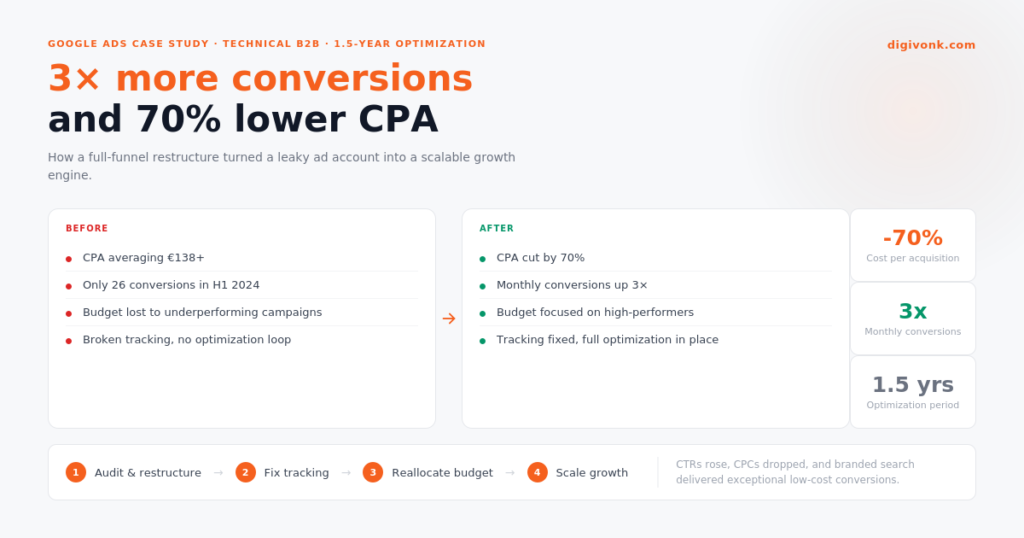
Campaigns were generating conversions, but at a high cost. The average cost per acquisition was above €138, while total conversion volume remained low. In the first half of 2024, the account produced only 26 conversions.
The main issues were:
- High CPA, averaging €138+
- Low conversion volume, with only 26 conversions in H1 2024
- Budget waste across underperforming campaigns
- Poor tracking setup, limiting optimization quality
- Limited visibility into what was actually driving results
For a technical B2B advertiser, this created a common but costly situation: campaigns were running, budgets were being spent, but the account lacked the structure and data clarity needed to scale.
Strategy
The goal was simple: turn the account from high-cost and low-yield into a scalable performance engine.
To do this, the focus shifted from “more budget” to better allocation, cleaner tracking, and sharper campaign structure.
The strategy was built around four priorities:
- Fix conversion tracking
Reliable data was needed before making major optimization decisions. - Audit campaign performance
Each campaign was reviewed based on CPA, conversion volume, CTR, CPC, and overall contribution to pipeline activity. - Restructure the campaign portfolio
Budget was moved away from inefficient campaigns and redirected toward proven opportunities. - Launch a stronger branded search campaign
Branded demand was captured more effectively, helping generate low-cost, high-intent conversions.
This created a clearer split between campaigns that supported visibility, campaigns that drove demand, and campaigns that converted existing intent.
Execution
Over a 1.5-year period, the account was audited, restructured, and optimized step by step.
The first phase focused on tracking. Conversion actions were reviewed, corrected, and improved so campaign decisions could be based on cleaner data. This gave a more accurate view of which campaigns were actually contributing to results.
Next, the campaign portfolio was restructured. Underperforming campaigns were reduced, paused, or reorganized. Budget was streamlined toward campaigns with stronger performance signals.
A new high-performing branding campaign was also launched. This helped capture high-intent traffic at a much lower cost per conversion. For a technical B2B advertiser, this was especially valuable because branded search often catches prospects who are already familiar with the company, solution, or product category.
Ongoing optimization focused on:
- Improving budget allocation
- Reducing inefficient spend
- Increasing conversion volume
- Lowering CPA
- Improving CTR
- Reducing average CPC
- Scaling campaigns with proven performance
The result was a cleaner, more efficient account structure with stronger data, better budget control, and clearer growth potential.
Results
The impact was clear.
Over the optimization period, the account achieved:
| Metric | Before | After | Impact |
|---|---|---|---|
| Cost per acquisition | €138+ average | 70% lower | Major efficiency gain |
| Conversion volume | 26 conversions in H1 2024 | 3x monthly growth | Stronger scalability |
| Campaign structure | Fragmented | Restructured | Better budget control |
| Tracking | Poor visibility | Improved tracking | Smarter optimization |
| CPC and CTR | Inefficient performance | CPC down, CTR up | Higher traffic quality |
The account moved from a high-cost, low-volume setup to a more scalable and efficient marketing engine.
Most importantly, the improvements were not driven by simply increasing spend. They came from better tracking, sharper analysis, and hands-on campaign management.
Key Outcomes
The campaign restructure delivered three major wins:
1. CPA dropped by 70%
By cutting inefficient spend and improving conversion tracking, the account became significantly more cost-efficient.
2. Monthly conversions increased 3x
Stronger campaign structure and better budget allocation helped generate more conversions without relying on wasteful scaling.
3. Budget was redirected toward what worked
High-performing campaigns received more focus, while low-yield campaigns were reduced or eliminated.
Creative Insight
The biggest shift came from combining analytics with action.
Instead of treating every campaign equally, performance data was used to separate real growth drivers from budget drains. Branded search became a strong conversion source, while tracking fixes gave the account the clarity needed to optimize with confidence.
That was the turning point.
The account did not need more complexity. It needed cleaner data, sharper structure, and smarter decisions.
Takeaway
This case shows how strategic analytics and hands-on campaign management can dramatically shift Google Ads performance for technical B2B advertisers.
With the right tracking, structure, and budget discipline, even an underperforming account can become a scalable growth channel.
Ready to turn your campaigns into growth stories? Let’s spark the next one together.