Meta Ads Case Study: From Awareness Channel to B2B Lead-Generation Engine
Challenge
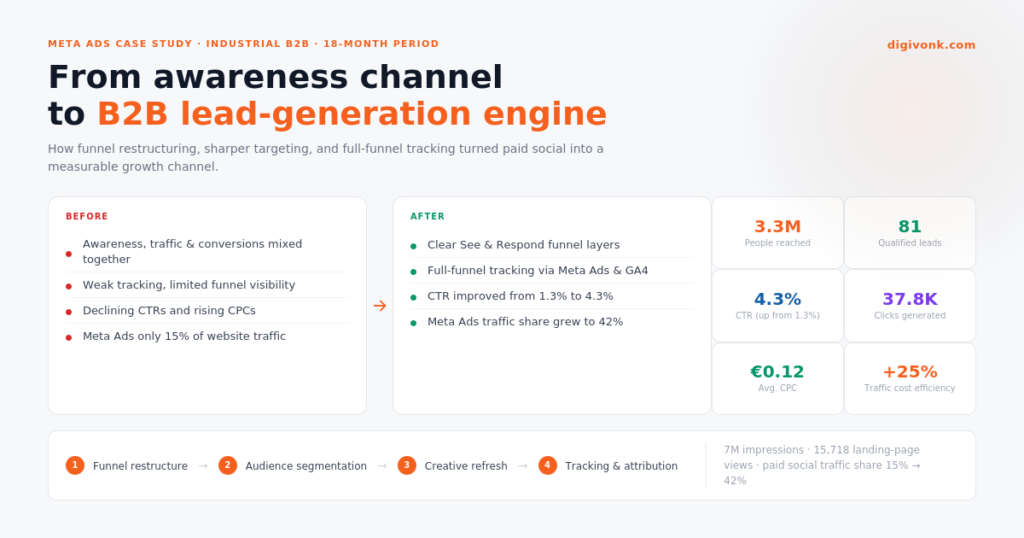
The client, an industrial B2B advertiser, was relying too heavily on branded search to drive digital performance.
Meta Ads were active, but they played a secondary role. Campaigns created visibility, yet they were not structured to support clear lead generation. Awareness, traffic, and conversion goals were mixed together, making it difficult to understand what was working and where the budget should go.
There were four key challenges:
- Paid social had a limited role in total website traffic and lead generation.
- Campaigns lacked clear separation between awareness and conversion objectives.
- Tracking was weak, with limited visibility into full-funnel performance.
- CTRs were declining and CPCs were rising due to outdated creatives.
The result was a paid social setup that reached people, but did not yet function as a scalable growth channel.
Strategy
Digivonk rebuilt the Meta Ads approach around a clearer funnel structure.
The goal was to transform paid social from a supporting awareness channel into a measurable lead-generation engine.
We separated the strategy into two layers:
See: campaigns focused on reach, visibility, and relevant audience exposure.
Respond: campaigns focused on traffic, landing-page views, and qualified lead actions.
This gave each campaign a clear job. Awareness campaigns were measured by reach and frequency. Conversion-focused campaigns were measured by clicks, landing-page views, brochure downloads, calls, WhatsApp actions, and cost efficiency.
The strategy combined sharper targeting, stronger creative testing, and better tracking through Meta Ads and GA4.
Execution
Funnel Restructure
The campaign setup was rebuilt into distinct See and Respond layers.
This created a cleaner structure for targeting, budget allocation, and performance measurement. Instead of forcing one campaign type to do everything, each layer supported a specific stage of the customer journey.
The See layer focused on building qualified visibility across relevant regional audiences.
The Respond layer focused on attracting users with higher intent and encouraging measurable actions on the website.
Audience Segmentation
Audience targeting was refined by region and behavior.
Instead of relying on broad audience groups, campaigns were segmented to better match local demand and user intent. Lookalike audiences were also created based on valuable actions, including brochure downloads and conversions.
This helped Meta find users who behaved similarly to people already showing interest in the client’s offer.
Creative Refresh
Outdated creatives were replaced with sharper ad concepts and clearer copy.
The new creative direction focused on stronger hooks, clearer value propositions, and better alignment with conversion intent. The aim was not just to increase clicks, but to attract users more likely to engage with the website and take action.
This helped reverse declining engagement and improve paid social efficiency.
Tracking & Attribution
Meta Ads and GA4 were integrated to improve full-funnel tracking.
This gave the client a clearer view of how paid social contributed across the journey, from first reach to landing-page visits and lead actions.
Key events included:
- Brochure downloads
- Calls
- WhatsApp clicks
- Landing-page views
- Traffic campaign performance
- Conversion-focused engagement
With better tracking in place, budget decisions became sharper. High-performing campaigns were scaled, while inefficient retargeting and broad awareness ads were reduced.
Results
Over 18 months, from April 2024 to September 2025, Meta Ads became a core performance channel for the business.
The rebuilt structure delivered both stronger reach and clearer conversion results.
Performance Summary
| Metric | Result |
|---|---|
| People reached | 3.3 million |
| Impressions | 7.0 million |
| Clicks | 37,795 |
| Landing-page views | 15,718 |
| Qualified leads | 81 |
| CTR improvement | 1.3% → 4.3% |
| CPC | €0.10–€0.14 |
| Paid social share of website traffic | 15% → 42% |
| Traffic campaign cost-efficiency | +25% improvement |
The most important shift was not just volume. It was quality and control.
Meta Ads moved from a broad awareness tool into a structured, measurable channel that could support real lead generation.
Key Outcomes
- Paid social became a key contributor to website traffic.
- Meta Ads traffic share increased from 15% to 42%.
- CTR improved from 1.3% to 4.3%.
- CPC dropped to a highly efficient €0.10–€0.14 range.
- The campaign generated 81 qualified leads through brochure downloads, calls, and WhatsApp actions.
- Full-funnel tracking improved through Meta Ads and GA4 integration.
- Budget was shifted away from weak campaigns and into proven growth drivers.
Creative Insight
The biggest performance lift came from creating clarity.
Before the restructure, campaigns were trying to do too much at once. Awareness, traffic, and lead generation were blurred together. That made optimization slower and performance harder to judge.
By splitting the funnel into See and Respond layers, each campaign had a clear purpose. The creative could be tailored to the user’s stage. The audiences could be refined by intent. The results could be measured with more confidence.
That clarity turned Meta Ads into a channel the client could scale.
Takeaway
For industrial B2B brands, Meta Ads can do more than create awareness.
With the right funnel structure, tracking setup, and creative testing system, paid social can become a cost-efficient source of qualified traffic and leads.
This case shows how a clearer strategy can turn an underused channel into a measurable growth engine.
Ready to turn your campaigns into growth stories? Let’s spark the next one together.